About
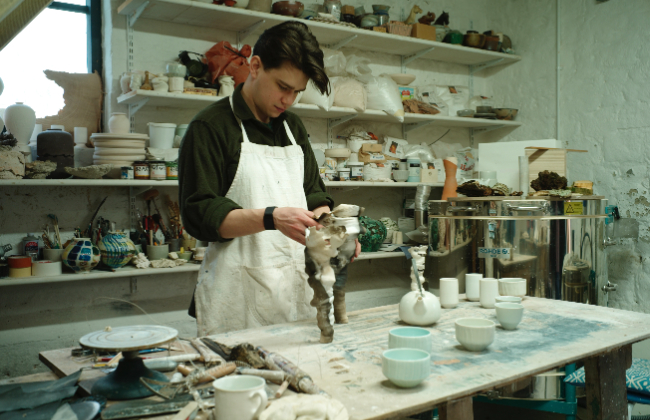
Sam Chatto studied Art History at Edinburgh University and trained as a potter at the Northshore Pottery. Chatto then apprenticed under the renowned porcelain master Yagi Akira in Kyoto, where he learned the rigorous techniques of Japanese wheel-throwing. It was there that he first became captivated by the differences between Western and Japanese approaches to ceramics. Since then, he has primarily focused on porcelain.
For Chatto, porcelain is an immaculate material of memory, which keeps its own life throughout the process of throwing. The pieces he creates seek to capture movement, fluidity, and a sense of life.
Chatto began experimenting by incorporating small amounts of local clays into his porcelain sculptures. This blending not only created unique colours that contrasted with the pure whiteness of porcelain but also introduced an element of chance in the unpredictable, naturally occurring conditions of wood-firing kilns. Chatto finds a particular resonance in this process of creation which is deeply tied to the forces of nature and their unpredictability.
In his work, Chatto always engages with his surroundings and maintains a close connection to nature. During the autumn of 2024 he had a studio residency at Senter for keramisk kunst in Ringebu, where he explored different local stoneware clays and developed an unconventional method of combining rough stoneware with pure porcelain clay. The dramatic natural surroundings of Ringebu, which have attracted artists for generations, added important impulses to the process, imbedding the arch-Norwegian forest landscape into the sculptures.
Chatto feels that the rural landscapes of Japan and Norway are reminiscent of the landscapes in his home Britain, particularly in Scotland, where he spent much of his childhood and adult life. He was struck by the overwhelming power, elements, and unpredictability in Japan’s nature, which he saw as more visceral and visible in Japan. In Chatto’s glazes elements of nature are also apparent; celadon represents air, sky, and the sea, while the works fired in a wood kiln evoke earth, rocks, and stones. Japanese landscapes have provided Chatto with deep inspiration, and his time in the country has suggested new possibilities and ambitions that can be applied to delicate materials.